Rewire.
How AI is Rewiring Relationships at Work.
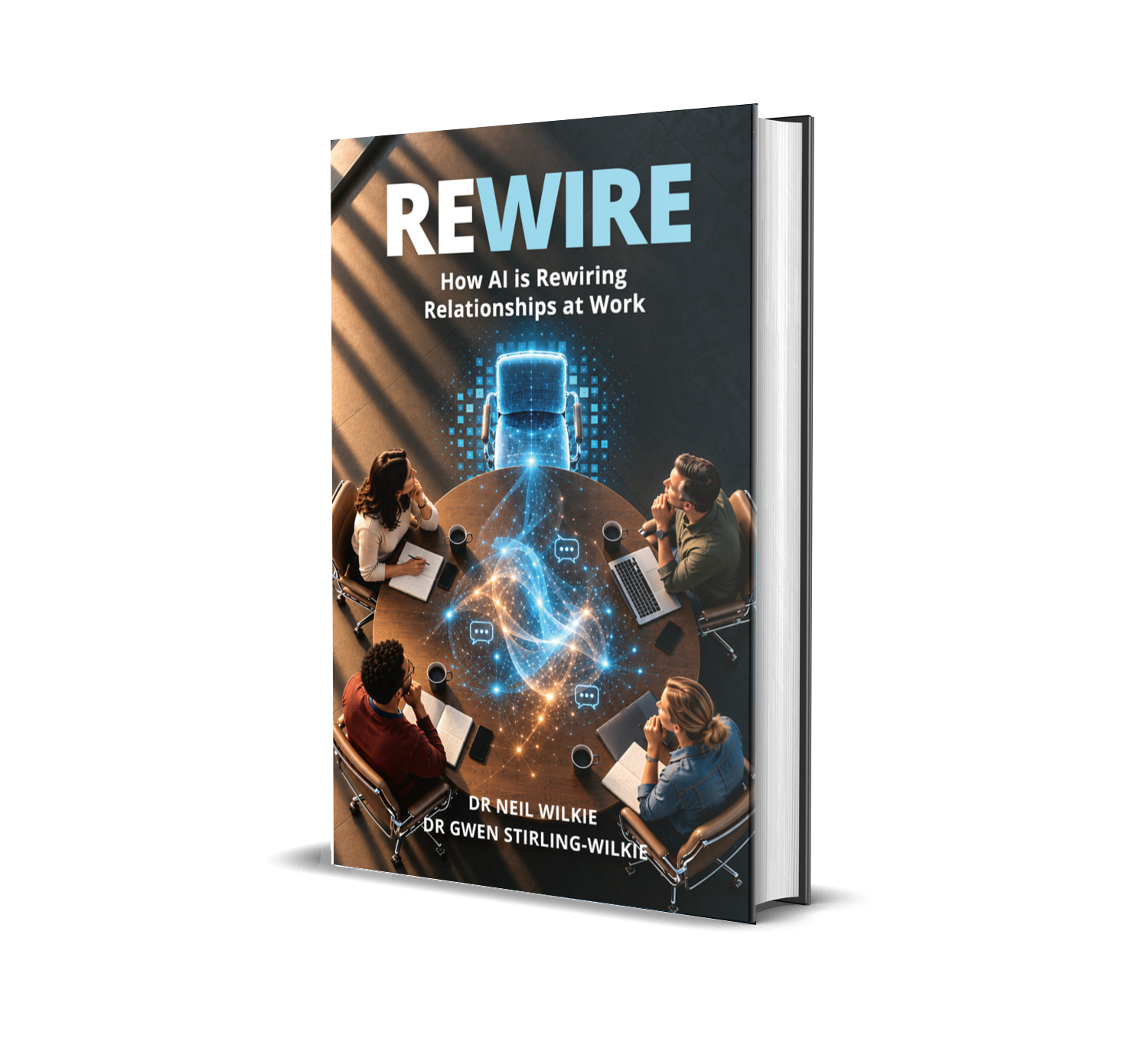
Rewire
How AI is Rewiring Relationships at Work
Dr Neil Wilkie & Dr Gwen Stirling-Wilkie
Insightful, original and immensely readable, Rewire addresses the question every leader should be asking: what happens to an organisation when efficiency improves but its human relationships begin to disappear? This is an important book that deserves to be read, and acted upon, in boardrooms everywhere.
— Colin Barrow, author of The 30 Day MBA
UK
US
The Book
Everyone has a story about AI at work. The optimists say it is the productivity revolution we have been waiting for. The pessimists say it is coming for our jobs. Both stories show up on the metrics and dashboards. Neither describes what is actually happening in the room.
What is happening is quieter, and it matters more. The relational fabric of organisations — trust, connection, mentoring, the texture of how people work together — is being quietly thinned.
- Meetings are more polished, and less honest.
- Mentoring has lost the time it needs.
- Long-serving people are leaving with knowledge no AI can hold.
- Graduates are arriving to find the first rung of the ladder gone.
The metrics report record performance. Underneath them, something is changing that will show itself over the coming months and years in the quality of decisions, the strength of cultures, and an organisation’s capacity to do hard things together.
Rewire gives it a name: hollow competence — the appearance of capability, resting on a process the person has not themselves undergone. When it spreads across a team or a board, it becomes more dangerous: an organisation that can no longer tell what it does not know.
This is not speculation. When an AI tool arrived in four Polish endoscopy centres, experienced doctors — each with more than two thousand procedures behind them — lost roughly a fifth of their unaided ability to spot precancerous growths within three months. Not because the tool failed. Because it worked.
Rewire is not a book against AI. It is a book about using it without losing what makes organisations work — It shows leaders how to begin restoring what has been thinned.
Neil & Gwen in conversation
A therapist and an organisational consultant, talking about what AI is doing to the way people work together — and occasionally disagreeing about it.
Seven People. Seven Organisations.
The argument is carried by seven recurring characters, each of whom notices something they cannot yet name:
- Sarah, chief executive of an insurance company, whose leadership team has never presented better — and whom she has never felt further from.
- Tom, 24, a graduate in advertising, producing work that is technically fine but teaching him nothing.
- Anna, an engineering director in precision manufacturing, watching the everyday touchpoints where know-how used to pass between people disappear from a spotless factory floor.
- Priscilla, a senior partner in a Magic Circle law firm, who can no longer give her juniors the mentoring that made her.
- Richard, chairman of a FTSE 250 retailer, leaving a flawless, unanimous board meeting with the sense that something was badly wrong.
- Rashpal, a management consultant who gave a client the right answer — and is not sure it was his answer.
- Mark, a team leader in a Leeds contact centre, twenty-six years with the company, feeling the texture of the floor change beneath the metrics.
None of them is one person. All of them are real. They are composites drawn from the authors’ combined fifty-plus years of clinical and consulting practice — and by the end of the book, each has found the word for what is happening, and somewhere to start.
Recognise yourself in one of them? The book includes a reading path for each character, so you can start where your own work is closest — and you can follow the characters beyond the final page.
Read Chapter One free
It is 9:47 on a Tuesday morning, and Sarah Maitland cannot work out what is wrong with her own meeting.
The presentations are flawless. The decisions land cleanly. Nobody disagrees. And Sarah, six years into leading this team, has never felt further from it.
Chapter One, A Tuesday Morning, follows Sarah through that meeting, then turns to a study of experienced doctors whose own skills quietly declined while their AI tool was working perfectly. If you have ever left a meeting that went well and felt uneasy, start here.
Enter your email and we’ll send you Chapter One straight away. You’ll also hear when new Rewire Conversations go up, and what happens to the characters after the book ends.
Story and analysis, side by side
Each chapter opens inside a character’s experience, then steps back to examine what it means and why it is happening. The book moves in five parts:
- The Recognition — the moment before anyone has a word for the problem.
- The Hollowing — what is being lost: honest meetings, psychological safety, organisational memory, and the creative friction good decisions need.
- The Practice — what each character does, in their own organisation, to begin rebuilding.
- The Choice — how boards can govern AI through a relational lens, and the new contract between organisations and the people in them.
- The Work — the tools to take it into your own organisation.
Contents
Everyone has a story about AI at work. The optimists say it is the productivity revolution we have been waiting for. The pessimists say it is coming for our jobs. Both stories show up on the metrics and dashboards. Neither describes what is actually happening in the room.
What is happening is quieter, and it matters more. The relational fabric of organisations — trust, connection, mentoring, the texture of how people work together — is being quietly thinned.
- Meetings are more polished, and less honest.
- Mentoring has lost the time it needs.
- Long-serving people are leaving with knowledge no AI can hold.
- Graduates are arriving to find the first rung of the ladder gone.
Part One — The Recognition
- A Tuesday Morning
- The Six Elements at Work
- The Vanishing Rung
- The Disappearing Touchpoints
- The Fading of Mentorship
- The Erosion of Trust
Part Two — The Hollowing
8. Psychological Safety in the Age of the Algorithm
9. The Texture of the Room
10. What Walks Out With Them
11. Creative Friction
Part Three — The Practice
13. Designing for Dialogue
14. Restoring the First Rung
15. Rebuilding the Informal Network
Part Four — The Choice
17. The Relational Contract
Part Five — The Work
The Relational Audit™
The Relationship Paradigm: A Quick Reference
The Omni Organisation: A Framework Guide
Afterword
Afternote: On Working with Claude
About the Authors · Further Reading · Acknowledgement
Tools You Can Use On Monday
Wilkie and Stirling-Wilkie… do the harder thing: handing you small, unglamorous practices you can start Monday with no budget, no mandate, and no permission.
— Brian Elliott, CEO of Work Forward
Part Five, The Work, is built to be used by leadership teams rather than read straight through:
- The Discussion Guide — for teams that have read the book together and want to talk about what it has surfaced.
- The Relational Audit™ — a diagnostic any senior team can run on its own organisation.
- The Relationship Paradigm: A Quick Reference — the six elements that run through the book: Communication, Connection, Commitment, Fun, Growth and Trust.
- The Omni Organisation: A Framework Guide — what an organisation that takes the argument seriously is trying to become.
Measure it in your own organisation. The Relational Barometer™ is an eighteen-question instrument that sits alongside your existing engagement survey and reads relational health against how deeply AI features in people’s work. It is free to use online, and it scores itself.
Reading It As A Leadership Team?
If you are ordering ten or more copies for a board, executive team or leadership programme, get in touch and we will arrange to send you multiple copies directly. We can also join your team for the discussion, in person or online.
Who It Is For?
If you have valued Margaret Heffernan, Lynda Gratton, Daniel Susskind or Amy Edmondson, Rewire takes the AI question into the territory they have shown matters most: the relationships through which people actually work together.
Praise for Rewire
The Authors
A relationship therapist who spent his career in boardrooms, and an organisational consultant who has spent hers reading the rooms where leadership teams meet.
Dr Neil Wilkie spent more than fifty years in business — as a chief executive, chairman, MBO and MBI leader and mentor to business leaders — before noticing that what he had been watching in every boardroom was relationships. He is now a relationship therapist and Visiting Fellow at Middlesex University, where he researches neural synchrony: the measurable coupling between the brains of people in genuine conversation. He created Duo Coaching and the Relationship Paradigm. His most recent book is Real: Love, Longing and the Lure of Artificial Intimacy.
Dr Gwen Stirling-Wilkie is an organisational consultant, business leader and educator of leaders, and a Visiting Fellow at Middlesex University. After fifteen years as a commercial leader in retail, she has spent twenty-five years working with leadership teams on the relational side of organisational change. She created Systemic Responsiveness and is the author of Omni-Working.

They sail together on Moon River, which is where a good deal of this book was written, and argued out.
The unusual pairing of the co-authors offers a unique perspective. It is a marvellous book that should get wide attention.
— Jeff Grout, author, speaker, CEO
A book about AI, written with AI
Working with boards and leadership teams
Neil and Gwen work with boards, executive teams and senior leadership teams to draw out, interpret and act on the relational consequences of AI in their organisations.
Speaking. Neil and Gwen speak together and separately to boards, leadership conferences and professional bodies on AI, trust and the relational fabric of organisations. Talks can be keynotes, fireside conversations, or workshops built around the Relational Barometer.
For media, podcasts and event organisers
High-resolution cover, author photographs, short and long biographies, and a one-page summary of the book are available. For interviews, review copies or speaking enquiries, contact neil@neilwilkie.com